Part of my ‘How to Teach English at Home’ series for homeschooling parents
What is phonics? (And why it matters for learning to read)
You will most likely encounter phonics if you are home educating younger children. Teaching reading through phonics is about getting children to be aware of and recognise different sounds. Children begin to associate specific sounds with specific letters.
They begin to learn that sounds + letters = words and this is where the magic of reading begins!
You then show your child how to put the sounds together to make words. This is called blending.
Using this knowledge, children will start decoding and reading words. The goal is to be able to decode, not to memorise. By being able to both build up and break down words, your children are beginning the important skill of independent reading.
You start with simple sounds first: s, a, t, p, i, n. You teach the sound the word makes (rather than the name of the letter as if you’re learning from the alphabet song).
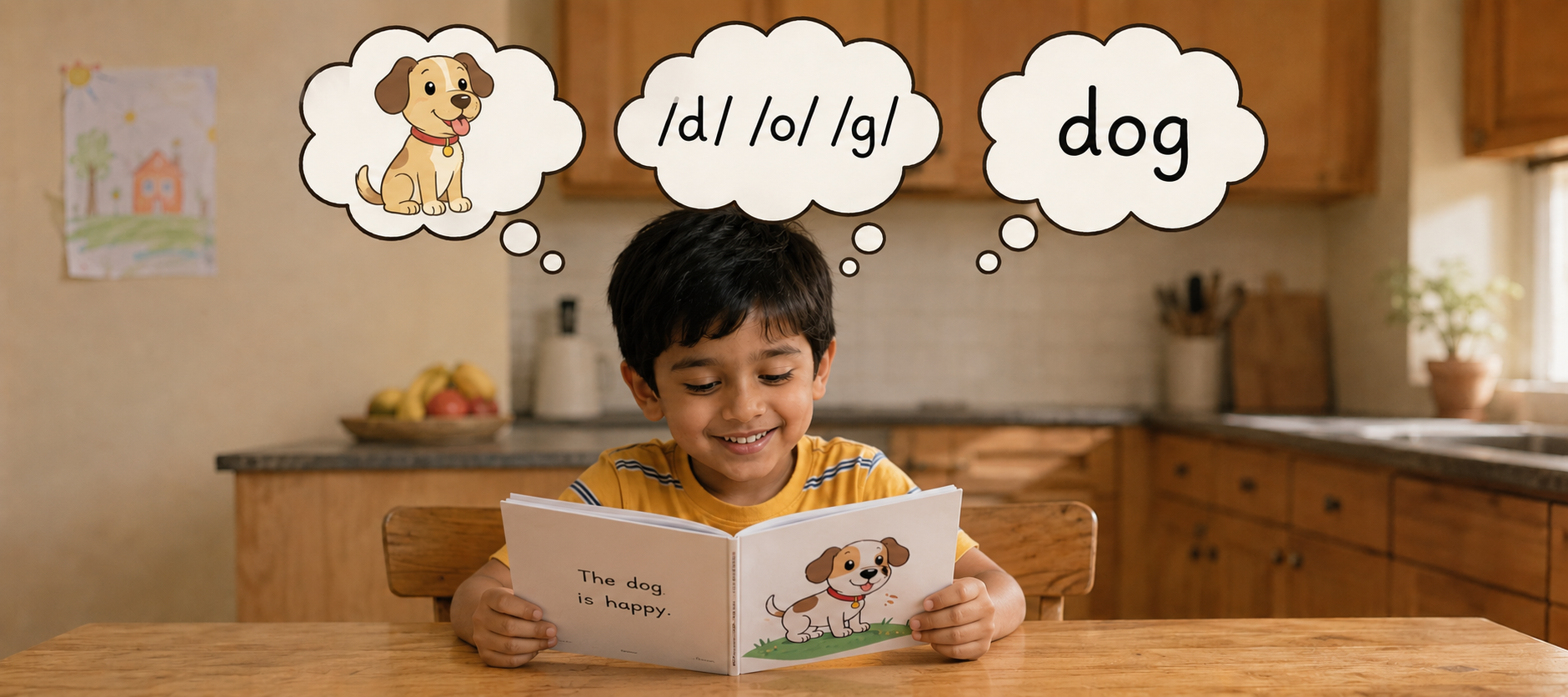
Then you show children how to blend the sounds to make words: /d/ /o/ /g/ = dog.
How do phonics work at school?
To give you an idea of school equivalents, they begin teaching simple sounds in Reception (4-5 years old) and finish with more complex sounds by the end of Year 1 (5-6 years old). By Year 2 (6-7 years old) children will start to become more fluent readers and learn different spelling patterns, prefixes, suffixes etc.
This is not to say that you must follow the same timings - everyone can learn at their own speed and pace.
How phonics works: the basic building blocks
The teaching of phonics includes us adults having to learn a few different words so that we know what we are teaching our children - skip to the end of this article for a full glossary of all the key phonics words. Here are some of the key ideas broken down for you.
Phonemes (sounds) explained simply
A phoneme is a single sound and is the smallest sound part of a word. This is the easiest place to start. Remember, a phoneme is a sound, not a letter.
For example:
- pin has 3 phonemes: /p/ /i/ /n/
- chin has 3 phonemes (even if it has 4 letters!): /ch/ /i/ /n/
As a gentle start to phonics, you would start identifying the phonemes with your child, without even reading any words. You practise it as a natural part of everyday language, like:
“Mat? How many sounds are in mat? /m/ /a/ /t/ Yes, three sounds, great job!”
Graphemes (letters and letter groups)
Graphemes are the written representation of a sound. These written representations could be a sound made up of 1 letter, 2 letters or more.
For example:
- “s” is a grapheme
- “sh” is a grapheme made up of 2 letters
- “igh” is a grapheme made up of 3 letters
Blending sounds to read words
Once your child can recognise some different sounds, the next step is to blend the sounds together to read words.
For example:
- In sit, they will recognise the sounds /s/ /i/ /t/ and repeat them, blending them until they recognise the word sit
Segmenting words into sounds
Whereas blending is about identifying different sounds and merging them to read a work, segmenting works the opposite way. Children start with a known word and try to break it down into the separate sounds. This forms the basis of beginning to spell words and write.
For example:
- A child wants to write pat, so they segment the word into separate sounds /p/ /a/ /t/ and use this to help them spell out the word.
When should you start teaching phonics?
Signs your child is ready to begin phonics
Here are some signs that your child is ready to begin phonics:
-
They enjoy listening to stories and looking at books.
-
They can hear and identify sounds in words (for example, noticing that "sun" starts with an /s/ sound).
-
They enjoy rhyming games and songs.
-
They show curiosity about letters, signs, or words they see around them.
-
They can focus on a short activity for a few minutes at a time.
Side note: phonics is not the same as the alphabet! Children do not need to know the alphabet or be able to write letters before beginning phonics. And equally, a child who has memorised the alphabet song by heart is not necessarily ready to begin phonics unless they are showing other signs like those above.
What to do if your child is not ready yet
If you are not seeing evidence of any of the readiness signs above, do not panic! There is no advantage in forcing formal phonics before a child is ready. A strong foundation of language, conversation, stories, and play will make learning to read much easier when the time comes.
Here are some ages that different children learn to read in different countries:
-
England: typically 4-5 years old in Reception
-
France: typically around 6 years old
-
Finland: typically around 7 years old
Remember: learning to read earlier or later is not better nor worse - the beauty of homeschooling is that we can follow our children’s cues and begin when they are ready, not according to any one else’s schedule.
How to keep your child interested in language in the meantime:
-
Continue reading aloud together every day.
-
Play listening games, rhyming games, and singing activities.
-
Talk about sounds naturally during everyday activities.
-
Let children explore books without any pressure to read them.
-
Wait and revisit phonics in a few weeks or months if there is little interest.
How to teach phonics at home (step-by-step method)
- Step 1: Teach the sound (not the letter name)
- Step 2: Practise hearing and saying sounds
- Step 3: Blend sounds into simple words
- Step 4: Start reading simple decodable words
- Step 5: Build confidence with repetition
Learning phonics at home in 30-minute daily sessions:
5-10 minutes: sound introduction
Try out short, regular practice. Either teach this yourself or watch an online teaching video like: Jolly Phonics
5-10 minutes: oral blending games
Play oral blending games - look at the games in the Resource ideas section below
5-10 minutes: reading decodable books
Link to real reading - practice reading a phonics book together. Take it in turns to read the book 3 times: you read, read together, then your child reads. Don’t be worried about reading the same thing again and again. At this age, practice and repetition are what is needed the most.
Why does short, daily practice work best?
When learning to read and write, short daily practice works better than longer, less frequent sessions because reading is built from lots of small skills that need regular repetition to become automatic.
Short, daily sessions will:
-
Build memory through repetition
-
Match young children's attention spans
-
Prevent overwhelm
-
Create a routine
-
Build confidence
Short daily phonics sessions are effective because they provide regular repetition, match young children's attention spans, and help new reading skills become automatic over time.
Resource ideas:
Letters and Sounds: https://letters-and-sounds.com/
This website gives you a breakdown of the different phases of sounds and has plenty of free printable resources, as well as links to free online practice games and videos.
PhonicsPlay: https://www.phonicsplay.co.uk/
This website is a top resource for learning all about teaching phonics. It has a guide for parents and lots of lessons and games that will work for your children. It is priced very reasonably and well worth the investment.
You can also type in ‘phonics book sets’ into Amazon and get plenty of different recommendations of books to read. Moreover, lots of people are selling lightly used sets like this on Facebook Marketplace or on Vinted.
Phonics Glossary for Parents
Blend (Blending): Putting individual sounds together to read a word. For example, blending /c/ /a/ /t/ to read "cat."
Segment (Segmenting): Breaking a word into individual sounds. For example, "dog" becomes /d/ /o/ /g/.
Phoneme: The smallest unit of sound in a word. "Ship" has three phonemes: /sh/, /i/, /p/.
Grapheme: The written letter or letters that represent a sound. For example, the grapheme "sh" represents one sound.
Digraph: Two letters that work together to make one sound, such as "sh," "ch," "th," or "ai."
Trigraph: Three letters that make one sound, such as "igh" in "light."
CVC Word: A simple word with a consonant-vowel-consonant pattern, such as "cat," "dog," or "sun."
Decodable Word: A word that can be read using the phonics sounds a child has already learned.
Decodable Book: A reading book containing mostly words that match the phonics knowledge a child has been taught.
Sound Talk: Saying words by stretching them into individual sounds, such as /m/ /u/ /m/ for "mum."
Pure Sounds: Pronouncing letter sounds without adding an extra "uh" sound. For example, saying /m/ rather than "muh."
Letter Formation: The correct way to write letters, including where to start and which direction to move the pencil.
Sight Word: A word a child learns to recognise instantly without needing to sound it out each time.
High-Frequency Word: A word that appears often in reading and writing. Examples include "the," "and," and "was."
Tricky Word: A word that cannot be fully decoded using the phonics rules a child has learned so far. For example, "said" or "one."
Consonant: A speech sound made by partially or completely blocking airflow, such as /b/, /t/, or /m/.
Vowel: The letters a, e, i, o, and u, which represent open speech sounds.
Initial Sound: The first sound in a word. The initial sound in "sun" is /s/.
Final Sound: The last sound in a word. The final sound in "cat" is /t/.
Onset and Rime: The onset is the beginning sound(s) of a word, and the rime is the rest. In "cat," "c" is the onset and "at" is the rime.
Synthetic Phonics: A method of teaching reading that starts with individual sounds and teaches children to blend them into words.
Phonological Awareness: A broad skill involving hearing and playing with sounds in spoken language, including rhyming, syllables, and phonemes.
Phonemic Awareness: The ability to hear, identify, and manipulate individual sounds in spoken words. This is an important foundation for learning phonics.
Schwa Sound: The unstressed "uh" sound often heard in spoken English. Avoid adding a schwa when teaching letter sounds (for example, say /t/, not "tuh").